

The Three Thresholds
Pivotal moments arrive in three distinct forms. Each requires something different from us.

Not all thresholds are quiet.
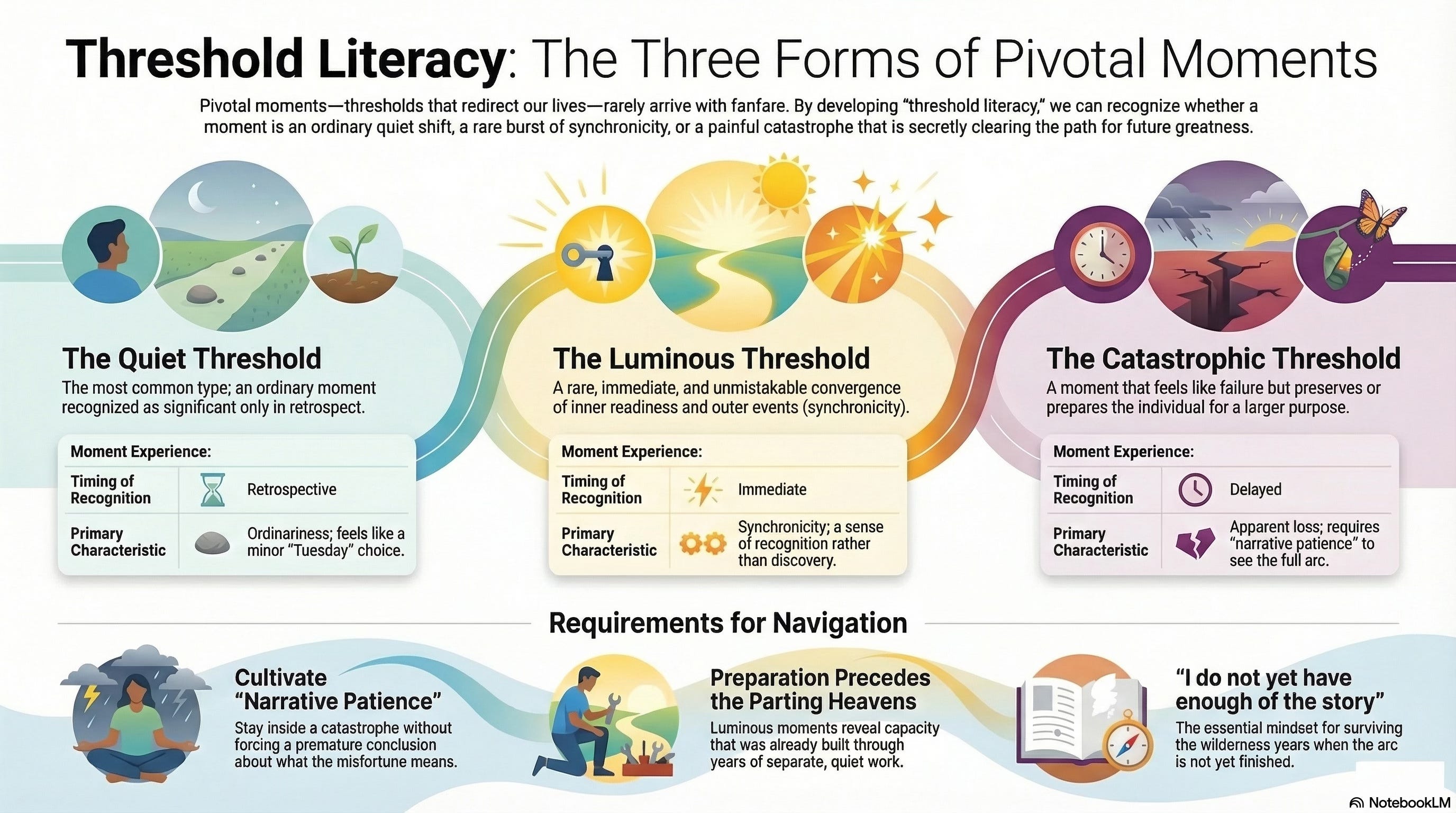
The previous post established the core problem: pivotal moments rarely announce themselves. The threshold that redirects everything looks, from inside, like Tuesday. But that is one pattern — the most common one, and the one we miss most consistently. There are two others, and understanding all three is the foundation of threshold literacy.
The Quiet Threshold
This is the threshold we have already met. The ordinary crossing. The conversation, the decision, the small step that forecloses a dozen other paths — all of it accomplished in the dark, without fanfare, recognized only in retrospect.
Its characteristic feeling is ordinariness. Nothing about the moment signals its significance. The pressure is present but not extraordinary. The choice feels manageable, even minor. Only later, when the consequences have had time to compound, does the shape of what happened become visible.
The quiet threshold is the most common type and the most costly to miss consistently. A life navigated without threshold literacy tends to be a life of retrospective recognition — a series of moments understood only after they have already reshaped everything.
The Luminous Threshold
There is another kind of threshold entirely — rarer, unmistakable, operating by entirely different rules.
This is the threshold that announces itself. Not gradually, not in retrospect, but immediately, totally, and to everyone present simultaneously. The moment when the right people, prepared by their separate journeys, arrive at the same point in time and space, make contact, and produce something that could not have been predicted from any of the individual parts.
Carl Jung called this synchronicity — the meaningful coincidence, the convergence of inner readiness and outer event that produces an experience of almost uncanny significance. These moments happen. People who have been inside them report them with a consistency that demands attention.
In July of 1968, Graham Nash walked into a house in Laurel Canyon where David Crosby and Stephen Stills were living. He heard a song he had never heard. On the third playing he opened his mouth and sang harmony — a part he had never rehearsed, to a song he had never encountered. What emerged from the three voices stopped the room in its tracks. Nash has described the moment as feeling not like discovery but like recognition — as though the harmony had always existed and they had simply located it. Crosby, Stills, and Nash existed from that moment forward, fully formed, as if they had been waiting to be found.
A few months earlier, Jimmy Page assembled four musicians who had barely met in a small rehearsal room in Soho. He asked John Paul Jones if he knew a song called Train Kept A-Rollin’. Jones said he didn’t. Page outlined the blues structure. Count it off, he said. The room exploded. Led Zeppelin began that afternoon, not gradually but all at once — a sound so complete and so distinctive that it was immediately, unmistakably itself.
In 1971, Emmylou Harris and Gram Parsons sat facing each other with their guitars and played for hours. Their voices did something together that neither voice did alone. Cameron Crowe, who knew both of them, said of that encounter: “ This is the way I want to fall in love.” The synchronicity was real, even though it was incomplete — Parsons died two years later, at 26, and the full arc of what they might have made together was never written. The luminous threshold doesn’t guarantee the journey that follows. It only guarantees that something irreversible has occurred.
What these moments share is their structure. The preparation happened elsewhere, over years, in separate rooms and separate lives. The convergence was simply where the threads arrived. And this is the crucial implication: the luminous threshold reveals readiness that was already there. It doesn’t create the capacity — it suddenly, unmistakably makes it visible. You cannot manufacture synchronicity. But you can become the kind of person to whom it can happen.
The heavens don’t part for the unprepared. They part for the ready, at the moment the preparation becomes visible.
The Catastrophic Threshold
The third type looks, from inside it, like the end of everything.
Winston Churchill wrote: “ One must never forget when misfortunes come that it is quite possible they are saving one from something much worse; or that when you make some great mistake, it may very easily serve you better than the best-advised decision.”
He wrote this from authority. He had lived it.
In the 1930s, Churchill was finished. That was not a minority opinion. It was the considered judgment of virtually everyone in British political life. His career was dissolving. His warnings about Hitler were dismissed as alarmist. He was widely regarded as a brilliant but erratic figure whose time had passed. The wilderness years were genuinely painful — he experienced serious depression, questioned his own judgment, and built walls at Chartwell with his hands because physical work was all that steadied him.
And yet the wilderness years were doing something he could not see from inside them. They were preserving him. Every year outside the machinery of government was a year he was not complicit in the appeasement consuming his colleagues. Every dismissed warning was building, brick by brick, the credibility that would make him the only possible leader when the moment arrived that required someone who had been right all along. His finest hour was not despite the wilderness years. It was because of them.
John Milton went blind at 43. For a poet — for any writer — the loss of sight carries a particular horror. He experienced it as a catastrophe. In a sonnet written shortly after the blindness descended, he asked, What use am I now? What can I offer? Paradise Lost was begun after the blindness and completed in it. Twelve books. Ten thousand lines. One of the supreme achievements of the English language — composed entirely in Milton’s mind and dictated to scribes because he could not see the page. There is a reasonable argument that the poem could not have been written any other way. The blindness cleared the field. It removed everything except what mattered most.
The catastrophic threshold requires what Churchill demonstrated, and Milton practiced: narrative patience. The willingness to remain inside the catastrophe without forcing a premature conclusion about what it means. Not optimism — Churchill was genuinely suffering, Milton was genuinely despairing. But the more demanding and more honest position: I do not yet have enough of the story. The arc is not finished.
Three thresholds. One underlying structure.
Quiet thresholds, luminous thresholds, catastrophic thresholds — three distinct forms of the same fundamental pattern. Three different ways that growth announces itself, or fails to announce itself, or announces itself in a language that looks indistinguishable from loss.
What they share is a structure that a comparative mythologist named Joseph Campbell spent a lifetime documenting — not in the invented patterns of storytellers, but in the deep architecture of human psychology itself.
That is where we turn next.